Welcome to the William A. Karges Fine Art Blog

Welcome to the William A. Karges Fine Art Blog, where you'll be able to learn about Early California and Southwest Paintings and discover information about Museum Exhibitions, Current News, Events, and our gallery's new acquisitions of original paintings created between 1870 and 1940 by a wide variety of artists. We'll feature biographies, photographs, links to websites of interest to collectors, video tours, and detailed histories of some of California's most influential and intriguing artists. Visit our Gallery at Dolores & Sixth Ave in Carmel-by-the-Sea, California to view our collection of fine paintings in person.

Wednesday, May 12, 2010

EARLY CALIFORNIA PAINTING IN CARMEL AND MONTEREY


Uniquely situated in a spectacular setting on the Pacific Ocean near the Del Monte Forest, Carmel-by-the-Sea has been a gathering spot for talented visual artists for well over a hundred years. The natural scenic beauty of the area has attracted and inspired dozens of notable Early California painters including Armin Hansen (1886 – 1957), William Ritschel (1864 – 1949), Percy Gray, and Francis McComas (1875 – 1938).

A recent exhibition at the Monterey Museum of Art, “Artists at Continent’s End: The Monterey Peninsula Art Colony, 1875-1907” clearly confirmed that the natural beauty, the rich history, and mild climate have drawn talented artists to Carmel/Monterey area since the late 19th century. Organized by the Crocker Museum in Sacramento, the display included the quiet tonalist nocturnes of Early California artist Charles Rollo Peters (1862 – 1928), who lived in the area of Monterey known as Peter’s Gate.


Charles Rollo Peters
"Adobe"
Oil on canvas, 10 x 16
SOLD


Other artists active in the late 19th century represented in the exhibition included Jules Tavernier (1844 – 1889), noted for his quiet scenes featuring California’s unique Redwood trees, and Chris Jorgensen (1860 – 1935). Jorgensen, often remembered for his highly detailed coastal scenes featuring the Monterey area’s famous Cypress Trees, built a boulder home in Carmel in 1905 which later became the La Playa Hotel.

The city of Carmel-by-the-Sea was founded in 1902, and incorporated in 1916. In 1905, the Carmel Arts and Crafts Club was formed to support the local artistic community. In 1906, following the San Francisco earthquake, a large number of talented artists moved to the Carmel area. The Carmel Arts and Crafts Club held frequent exhibitions of works by local artists and, in 1913, began providing lessons for aspiring painters. Distinguished artists William Merritt Chase, Xavier Martinez, and Mary DeNeale Morgan all taught six week classes arranged by the Club for $15 in those early days.


Mary DeNeale Morgan
"Cypress, Point Lobos"
Oil on board, 16 x 12
SOLD

In 1907, artists William Keith, Xavier Martinez, Karl Neuhaus, and Will Sparks founded the Del Monte Art Gallery, now the Herrmann Hall at the Naval Postgraduate School in Monterey. This was one of the very first galleries focused specifically on work by California artists.


In 1923, the distinguished tonalist painter Percy Gray (1869 – 1952) moved to Monterey. His remarkable, quiet, introspective watercolor paintings are cherished by collectors today for their ability to capture the mysterious, misty qualities of the local landscape.


Percy Gray "Poppies and Eucalyptus"    SOLD


In 1927, The Carmel Art Association was formed, founded by artists Josephine Culbertson and Ida Johnson. Early members of the group included Paul Dougherty and E. Charlton Fortune. Their mission statement explains that “the Association exists to provide its members with a permanent art gallery, to advance knowledge of, and interest in the arts, and to create a spirit of cooperation and fellowship among artists and the community”. The association is the second oldest operating non-profit artist cooperative in the United States, after a group in Rockport, Massachusetts, and to this day, member artists are always selected by their peers.

Fine examples of the rich artistic history of the Carmel/Monterey area can be found in museums throughout California and the United States. Important paintings by artists including a large selection of works by Impressionist E. Charlton Fortune are currently on view at the Monterey Museum of Art in the exhibition “Land and Sea: Paintings and Photographs of Monterey and Beyond”. The exhibition continues through October 24, 2010.

For additional information regarding the available paintings featured in this post, please call William A. Karges Fine Art at (800) 833-9185 in Carmel, or visit our website at www.kargesfineart.com

Thursday, May 6, 2010

Millard Sheets Exhibit at Pasadena Museum of California Art

On February 14, 2010, the exhibit “Millard Sheets: The Early Years (1926 – 1944) opened at the Pasadena Museum of California Art. Curator Gordon McClelland has organized the first cohesive survey of the first two decades of this early California painter’s career.


Emma Jacobson-Sive, Pasadena Museum of California Art Director of Public Relations, noted “It is often a challenge to narrow down works of a prolific and important artist, but the emphasis on the time period--the earlier part of Sheets’ career--certainly helped focus the exhibition. The works selected capture the changes and evolution of the artist’s style and by including some of his successful students’ work, they also capture his influence too.”


Millard Sheets was born in Pomona, California, in 1907. He attended the Chouinard Art School in Los Angeles, studying with Clarence Hinkle. Following a painting trip through Europe, Sheets returned to Los Angeles to teach at Chouinard. He is best remembered for his depression-era regionalist works known as the “California Scene Paintings.” Sheets spent 20 years teaching at Scripps College, and 6 years as the director of the Otis Institute before retiring to Mendocino County in 1960.


Millard Sheets


“The Capitol Building” was a part of a larges series Millard Sheets completed in the 1950’s and early 60’s as a commission to promote areas serviced by United Airlines. The images were reproduced in a series of United Airline calendars to promote the wonder of travel.

Sheets, well known for his individual paintings, is also known for the artworks featured in the interiors and exteriors of dozens of buildings in Los Angeles County. He also drew, 1n 1957, the Los Angeles County Seal

To view available paintings by Millard Sheets, visit William A. Karges Fine Art at Dolores and Sixth Ave. in Carmel, CA, call (800) 833-9185 or visit www.kargesfineart.com

Thursday, April 15, 2010

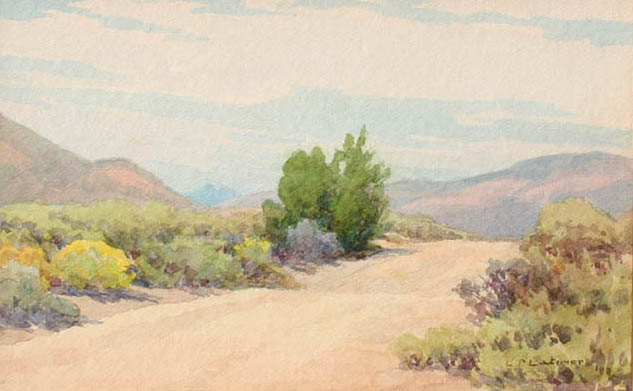
The Watercolors of Lorenzo Latimer

Lorenzo Palmer Latimer, widely known for his peaceful watercolor landscapes of northern California, Lake Tahoe, and the Sierra Nevada Mountains, was born in Placer County. After spending time as a child near the rolling hills on a ranch with his family in Windsor, California, the Latimers moved to San Francisco in 1869. Studying at the School of Design there, he graduated in 1882 and opened his own studio on Clay Street. As a member of the raucous, partying circle of artist Jules Tavernier (1844 – 1889), his career languished during this period, though he likely enjoyed himself very much.


Around 1833, when Latimer was in his mid-twenties, he began to teach outdoor painting classes, primarily to groups of women, who eventually, in 1916, became known collectively as the “Latimers”. Members of this group later became the founders of the Nevada Art Gallery, which eventually formed the basis for the Nevada Museum of Art. Latimer arranged many painting trips to Lake Tahoe and the Sierra Nevada Mountains. In 1914, he spent three summer months near Tahoe at Fallen Leaf and returned every summer for the remainder of his life.  A fine example of a watercolor from Fallen Leaf is shown below, including a lovely, quiet, contemplative composition inscribed on the back of the painting: “The Mountains from the long trail to the top of Mount Tallac - Fallen Leaf and Glen Alpine Region, 1916”.


Fallen Leaf Lake      SOLD


Influenced by Tavernier, he later became especially fascinated with the creation of paintings of California Redwood scenes.


Lorenzo Latimer’s works were often exhibited with the San Francisco Art Association, and he was later elected to artist membership in the exclusive Bohemian Club.


The Bohemian Club, located at 624 Taylor Street, San Francisco


From 1893 to 1894, he taught at the Mark Hopkins Insitute, whose name was later changed to the California School of Design. Much of his work was lost entirely in the earthquake and fire of 1906, and he moved, at that time, across the bay to Berkeley. Beginning in 1916, he regularly taught painting classes in Reno, Nevada.

Highway to Reno  SOLD


Lorenzo Latimer died on January 14, 1941 in Berkeley, and will always be remembered for his delicate watercolors that so gracefully captured the beauty of the California Redwoods, the Sierra Nevada Mountains, and the Lake Tahoe area.

Washoe Lake   SOLD


For additional information regarding available paintings by Lorenzo Latimer or other early California artists, please call (800) 833-9185 or visit our website at www.kargesfineart.com